
Thirty percent of profits vanishes before it lands. Not magic, just broken steps piling up – rotten containers sitting too long, paperwork snarled at borders, temperature breaks during transfers, juggling four or five providers who barely talk to each other. Ever watch a load get turned away on the dock, thinking there has to be another path? This walks through that option.
Once you reach the last line, clarity about 3PL will settle in. Food importers rely on it – here’s why. Picking the right partner involves quiet scrutiny. The details matter most when contracts appear. Questions must surface before any signature shows up on paper.

What is 3PL? (The Simple Definition)
A company might hand off parts of its shipping work to someone else. That outside help handles storage, moving goods, getting things through borders, plus sending orders out. This kind of support goes by another name – third-party logistics. Instead of doing it all themselves, businesses pass these tasks to a specialist.

Starting at two, many food importers drift toward three. That shift packs the most punch – handling isn’t just hauling anymore. Instead of only shipping boxes, storage kicks in, oversight tightens, records keep pace, tracking sharpens. Compliance tags along through paperwork that stays on beat.
Picture needing help moving boxes, but hiring movers rather than training your own team. That idea sits at the heart of what 3PL means. People typing that phrase seek clarity, not complicated terms filled with industry slang. Think of it like borrowing an entire shipping crew – equipment, skills, and all – from another company. Instead of constructing something yourself, you tap into ready-made support.
Why Food Importers Specifically Need 3PL
General logistics is complicated. Food logistics is a different level entirely. The pain points are specific, the compliance requirements are unforgiving, and the consequences of getting it wrong are costly in ways that go beyond a delayed delivery.
Here is what makes food importing uniquely difficult
Perishables move fast or not at all. A shipment of frozen seafood or fresh produce has a shelf life measured in days, sometimes hours. Every delay in customs, every warehouse handoff that breaks the cold chain, and every mislabeled pallet is a financial loss you cannot recover.
FDA and FSSAI compliance is non-negotiable. If you are importing food into the United States, the FDA requires strict documentation under FSMA (Food Safety Modernization Act). For imports into India, FSSAI standards apply. A 3PL that specialises in food logistics knows these frameworks and has processes built around them, so you are not scrambling to produce records during an inspection.
Short shelf life means demand forecasting matters. Unlike electronics or apparel, you cannot overstock food to hedge against uncertainty. You need a logistics partner who understands inventory velocity and can help you avoid both stockouts and spoilage.
Seasonal demand spikes are brutal without the right infrastructure. Festive seasons, harvest cycles, and regulatory import windows create sudden demand surges. A capable 3PL can absorb these spikes using shared warehouse capacity and flexible carrier networks that a standalone importer simply cannot replicate.
Consider a company importing specialty cheeses from Europe. They need temperature-controlled storage, customs brokerage familiar with dairy import regulations, last-mile delivery to specialty retailers, and returns handling for short-dated product. Managing all of that independently would require a full logistics team. A food-specialised 3PL handles it as a standard service.
What Services Does a Food 3PL Provide?
Some third-party logistics companies differ greatly from others. When it comes to handling food, specialised providers bring skills most standard shippers lack. What stands out? Pay attention to these details:
Temperature-Controlled Warehousing: Start here. Storage must handle room-temperature, cool, and frozen items – no exceptions. Real-time tracking of temps matters just as much as written proof of the cold chain. When a company hesitates to demonstrate how they log temperatures, that hesitation means something. Move on without looking back.
Customs Clearance and Documentation: Getting food through import rules means handling lots of papers on tight schedules. Some third-party logistics providers keep customs experts inside their teams, others work closely with outside pros trained in food categories like HS codes, plant health checks, advance FDA filings, and where ingredients come from.
Order Fulfillment and Last-Mile Delivery: After arriving at the warehouse and passing through customs, products must move fast. When items reach a distribution point, someone has to handle sorting, packing, and sending them out. A specialized logistics provider for food handles these steps. Orders go straight to stores, kitchens, or people’s homes – based on how you sell. The exact path changes with each company’s setup.
Returns and Reverse Logistics: Out of date inventory, broken items, or failed inspections – each needs a solid plan. When you work with a third-party provider, getting things back doesn’t turn into chaos behind the scenes.
Compliance and Labelling Support: Got to change labels on lots of imported foods before they hit local shelves – details like nutrition facts, local language, rules from different countries. Warehouses that handle storage might also repackage those labels, keeps things legal without hiring someone else just for that.
Start by numbering each point – or maybe toss in some icons – when going through provider options. That move speeds things up while cutting down on missed red flags along the way.
3PL vs In-House Logistics: Which is Right for You?
Most who bring food across borders eventually ask this. Handling shipping yourself seems safer somehow. Handing it off to a third party brings unease. Truth sits somewhere in between.
Use this decision framework to evaluate your situation
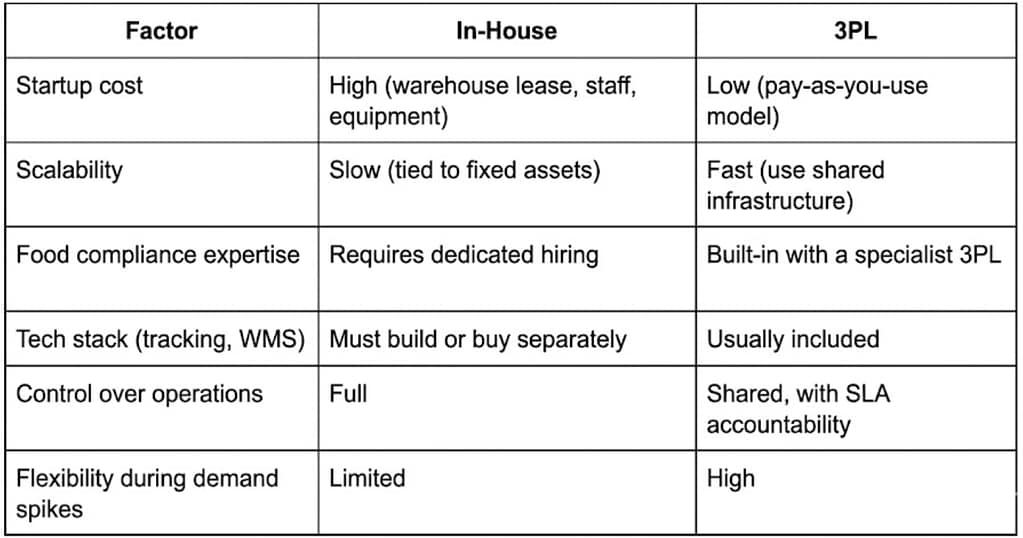
When in-house makes sense:When routes stay the same and loads remain heavy, owning equipment makes sense. If spending upfront fits your budget, building custom systems pays off over time. A limited set of products often means one design works everywhere. Heavy regular movement shapes how things get built.
When 3PL makes sense: Beyond growth, different products need varied cooling levels. Sourcing comes from various countries now. Instead of expanding clients, staff fix supply chain hiccups. Juggling suppliers eats into daily progress. Temperature needs differ across items. Work days shrink when coordination takes over. Multiple starting points mean extra complexity. Growth hides behind vendor management fatigue.
Most growing food importers find a 3PL makes sense. Costs add up favorably, since experts handle regulations. Years of building facilities vanish when support arrives ready-made.
Start by thinking – how many logistics providers do you handle right now? More than three might mean things are harder than they need to be. What about your cold storage records – are they ready if someone asks tomorrow? Delays happen, but when they hurt sales or upset customers, it signals something deeper. That kind of signal often means talking with a third-party provider could make sense.
How to Choose the Right 3PL Partner as a Food Importer
Start by thinking beyond shipping rates. That company will handle your orders every day. Instead of rushing, picture what happens when problems pop up. One delay could ripple through everything. Focus shifts once you realize their software must fit yours perfectly. Mistakes grow if systems clash. Trust builds slowly only if communication stays clear. Pick someone ready to adapt, not just react.
1. Cold Chain Capability: Start by requesting written proof of how they manage refrigerated storage. How low does the temperature go – stay consistent across shipments? Power cuts happen; find out their response when electricity drops. Generators on site? Monitoring systems that kick in automatically if something shifts?
2. Food-Grade Certifications: Checking if the supplier has SQF certification – this matters more than it sounds. Compliance with HACCP isn’t a bonus, it’s expected. Whatever market you’re shipping to, local food safety approvals must be in place. Skipping these? Not an option. Meeting them is simply where things begin.
3. Tech Integrations: Starts with whether their warehouse setup talks to your business systems – maybe through links to ERP, online sales tools, or buying platforms. Seeing stock levels update live matters more than most think. Runs on sheets alone? That detail often hints at deeper gaps. Ends there.
4. Container Planning and Procurement Support: When shipments get heavy, food moves slower. Container spots vanish fast near holidays. Lines that know your shipper pick up the phone quicker then. That gap – where others stall – is where deals tilt ahead.
5. Scalability and Geography: When shipments get heavy, food moves slower. Container spots vanish fast near holidays. Lines that know your shipper pick up the phone quicker then. That gap – where others stall – is where deals tilt ahead.
6. Pricing Model and Transparency: Knowing each cost tied to your shipments. Hidden charges like handling, storage, or packing often pile on top of base prices. Fuel adjustments and paperwork demands bring more expense too. Break down every provider’s pricing line by line. Match those details side-by-side with what you now pay.
7. References from Food Clients: Requesting feedback only from those moving food across borders – general shipping stories won’t help. Since temperature control and rules vary sharply, it makes sense to listen to voices that’ve dealt with spoiled loads or customs delays. Hearing straight from importers shows what really happens when shipments hit rough spots.
Prosessed supports food importers with procurement and container planning capabilities that connect directly to logistics workflows, which can simplify the handoff between sourcing and 3PL operations.
Start by grabbing a 3PL assessment list ahead of your upcoming talk with vendors. That way, you avoid overlooking key points – ones that tend to surface too late, once paperwork is already sealed.
How AI and Software are Changing 3PL for Food Importers
The 3PL industry is not static. Technology is fundamentally reshaping what a logistics partner can offer, and food importers who understand these shifts can use them to their advantage.
AI-Driven Demand Forecasting Instead of relying on historical averages and gut feel, modern 3PLs are using machine learning models to predict demand at the SKU level. For perishables, this means fewer stockouts and less spoilage. The system learns from your sales patterns, seasonal trends, and even external signals like weather and market pricing.
Container Optimisation Shipping containers are expensive and space is finite. AI-powered tools can calculate optimal loading configurations, reducing the number of containers needed per shipment and cutting freight costs meaningfully.
Automated Quoting Getting freight quotes used to take days of back-and-forth with carriers. Automated quoting tools integrated into 3PL platforms can surface rates in minutes, giving importers faster decision-making capability.
Real-Time Tracking End-to-end visibility across your supply chain, from origin factory to warehouse shelf to last-mile delivery, is now a standard expectation. If your 3PL cannot show you where your shipment is at any moment, that is a capability gap.
Prosessed is building in this direction, with procurement and container planning features designed specifically for food importers who need their sourcing and logistics to work together rather than operate as separate silos. The goal is not to replace your 3PL but to make the connection between what you buy and how it moves significantly smarter.
The editorial point here is straightforward: the 3PLs that will define the next decade of food logistics are the ones investing in technology now. When you are evaluating a provider, ask what their technology roadmap looks like, not just what their current capabilities are.
Common 3PL Mistakes Food Importers Make
Some seasoned importers still slip up on predictable errors while picking or managing a 3PL. These missteps pop up again and again – here’s where things usually go wrong, along with better ways forward.
Skipping checks on food-safe credential. That happens. Some third-party logistics providers carry broad shipping certificates but lack labels tied to edibles. For anything involving meals, standards like HACCP and SQF matter – no exceptions. Proof must exist. Request papers. Confirm they haven’t expired.
Fix: Before any agreement, get every food safety certificate they have. Look at when each one runs out. Confirm it yourself.
Ignoring cold chain SLAs in the contract. Wrong temps in storage or shipping might ruin goods, leaving risks behind. Without clear rules on acceptable ranges, how often checks happen, or alerts for problems written into the agreement, fixes vanish once trouble hits.
Fix: Add explicit cold chain SLAs to your 3PL agreement with defined remedies for breaches.
Overlooking customs documentation gaps. Shipping food across borders means filling out every form exactly right. One wrong number on a customs label might mean waiting extra days – maybe even getting pulled aside for checks. Some businesses think their shipping partner takes care of everything, yet never ask where that support stops and their own duties begin.
Fix: Map out the full documentation requirements for your import lanes and assign clear ownership for each document in your 3PL agreement.
Poor demand forecasting handoffs. Ahead of time, knowing what’s coming helps a 3PL arrange storage room and receiving schedules. When importers hold back forecast details, chaos follows – space runs short, workers are missing, trucks stack up at loading docks.
Fix: Establish a regular forecasting cadence with your 3PL. Share 4-week and 12-week demand projections so they can plan accordingly.
Choosing on price alone. Most low-cost 3PL bids skip what breaks down later. Saving a tenth on warehouse charges means little when spoiled goods arrive from a broken refrigerated link. That loss swallows any earlier gain fast.
Fix: Evaluate 3PLs on total cost of ownership, including the cost of potential failures, not just the headline rate.
FAQ: Your 3PL Questions Answered
How much does a 3PL cost for food importers?
Pricing shifts a lot depending on how much you move, what kind of goods you handle, along with required support tasks. Not every third-party logistics provider works the same way – many apply charges for receiving stock, holding it by the pallet or cubic space weekly, handling each shipment order, then shipping it out. If chilled conditions are necessary for imported food items, prices rise quite noticeably, often between one-seventh and two-fifths higher than standard room-temperature options. Someone moving modest quantities of perishable imports could see monthly expenses land anywhere from two grand up to eight thousand dollars, though bigger loads push totals upward. Full transparency matters – a detailed cost breakdown should always be shared before any agreement begins.
What certifications should a food 3PL have?
Start by checking for SQF – Safe Quality Food – certification, along with HACCP adherence, since that covers hazard analysis and key control points. Different countries add their own layer; take the United States, where any site holding edible goods must have FDA registration. Jump over to India, and it’s FSSAI that matters instead. Handling organics? Then dig into whether they hold proper credentials for organic storage too.
Can a 3PL handle customs clearance?
Most third-party logistics companies focused on food come equipped with their own licensed customs brokers or stick close to reliable outside ones. Still, what they actually do changes from one provider to another. A few take care of everything – filing FDA notices ahead of arrival, checking where goods originate, figuring out how much tax applies. Meanwhile, others step back when it comes to paperwork, leaving parts for you to sort through. The details matter. Define every task clearly before signing any contract.
What is the difference between 3PL and cold chain logistics?
Temperature-controlled shipping falls under logistics but targets items needing stable climate conditions. One kind of service partner handles these operations. Companies moving perishable goods often rely on third-party providers equipped for chilled transport and warehousing. These setups require special facilities plus strict handling rules during movement and storage. Some outside suppliers lack refrigerated support, so buyers must confirm this feature beforehand. Cold environments throughout the journey matter most when choosing a match.
Can a 3PL handle customs clearance for both the US and India?
Across different regions, certain global 3PL providers work in more than one country, already linked with customs agents in the U.S. and India alike. A few instead narrow their focus to just one location. When bringing goods into both places, go with a third-party logistics partner confirmed active in each area – or pick individual firms per region, making sure communication rules between them are spelled out clearly.
How do I know if my 3PL is performing well?
Start by watching how often deliveries arrive on schedule. That tells part of the story. Next comes whether orders match what was sent – spot-on counts matter. Temperature-sensitive loads? They must stay in range every single trip; track that number closely. Then there is paperwork speed – how fast things clear customs shapes timelines downstream. Damage at delivery breaks trust, so keep an eye on that total too. When it works well, your provider shares all this without waiting for you to ask, either online or in updates they send out.
Conclusion: Making Your Food Import Operation Work Smarter
Start late, finish early – that’s how tight food shipping windows feel. Juggling rules from country to country eats up hours before breakfast. When weather shifts buying patterns, plans crack like dried soil. Every truck delay chips away at profit, slowly. Smooth moves on the ground? That shapes what customers actually pay. Winning isn’t just in the product; it lives inside every warehouse decision.
A strong third-party logistics provider takes heavy tasks off your shoulders, swapping them for solid systems, real skill, and clear responsibility. What matters most? Picking someone fluent in food – not just a carrier that bolted on refrigerated space to an ordinary warehouse.
Start by looking past the warehouse walls. Your sourcing choices ripple through every part of delivery flow. One wrong move in container setup can quietly lift total expenses. What you predict today molds how much space you’ll need tomorrow. Teamwork between buying and moving goods wipes out wasted effort. Efficiency grows when these pieces stop working alone.
See how Prosessed helps food importers streamline procurement and container planning so your supply chain works as one connected system rather than a series of handoffs.